[Repost from 26 Jan 2018]
“No New Zealander who loves his country can read, without indignation, the chronicle of the collectors’ raiding of the forests. Even such a bird-lover as Sir Walter Buller had his heart hardened when the collecting fervour was upon him. That is the way with collectors in all countries, whatever may be the object of their search. They may be perfectly upright god-fearing persons in all matters except their hobby. For them, one may vary slightly an old proverb and make it read thus :—’All’s fair in love —and collecting.’” [1]
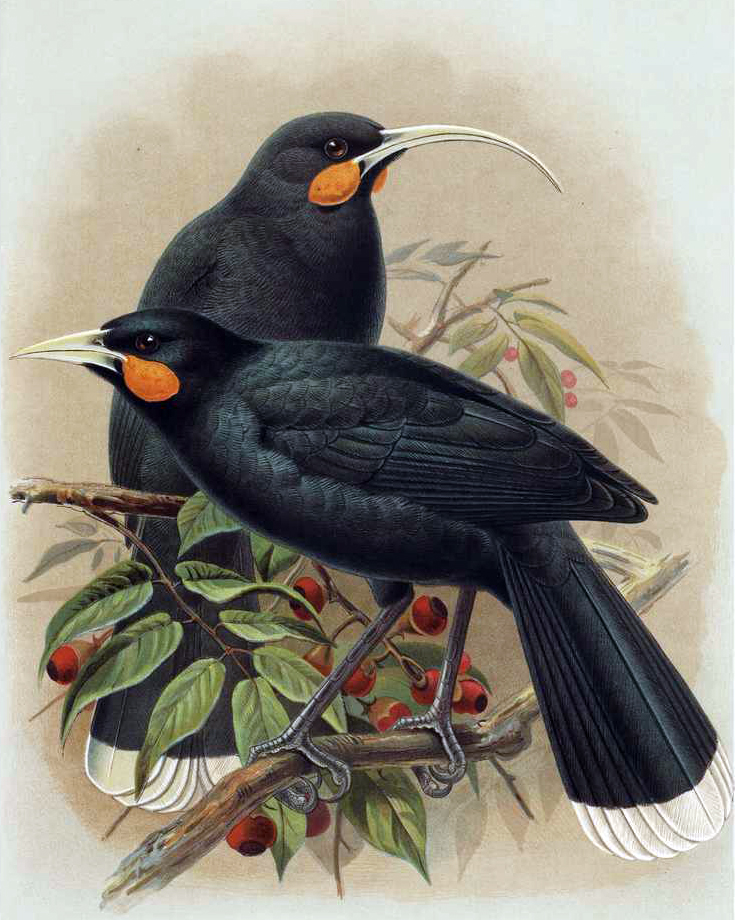
The huia was an iconic New Zealand bird. Along with the kokako and saddleback, it was one of only three members of a unique genus of wattlebirds. It featured on the threepenny stamp and a sixpence. Yet the huia went from uncommon but secure to presumed extinct in only forty years.
Letters and reports from contemporary New Zealand newspapers tell the story of the slow-motion tragedy of the commons that sent the huia into oblivion.
The huia was of great importance to the Maori, who considered the huia’s tail feather a symbol of rank. There are many accounts of the presentation of huia feathers to prominent Europeans in New Zealand. For instance, a huia feather was interwoven in the funeral wreath of Sir George Grey. [2]
Yet the collision of a symbol of chiefly rank with the desire of the public to “touch the robe” of royalty played a major role in the huia’s demise.
Walter Buller, author of A History of the Birds of New Zealand, collected many huia specimens.
“We camped that night near the bed of a mountain rivulet, in a deep wooded ravine, and soon after dawn we again heard the rich notes of the huia. Failing to to allure him by an imitation of the call, although he frequently answered it, we crossed the other side of the gully, and climbed the hill to a clump of tall rimu trees Dwcydiwn cupressinwni, where we found him. He was perched on a high limb of a rimu, chiselling it with his powerful beak, and tearing off large pieces of bark, doubtless in search of insects and it was the falling of these fragments that guided us to the spot and enabled us to find him. […] This solitary bird, which proved when shot to be an old male, had frequented this neighbourhood as we were informed by the natives for several years, his notes being familiar to the people who passed to and fro along the Otari track leading to Taupo. ” [3]
Mass shootings of the birds were still occurring in the 1870s.
“The natives of Te Ore Ore (some twelve in number), have just returned from a huia shooting expedition, and they succeeded in bagging three hundred birds. The scene of slaughter was the bush in the vicinity of Alfredton. Such wholesale slaughter of native game, especially the huia (a very rare and beautiful bird), should be put an end to. ”[4]
But by the late 1870s, the huia’s increasing scarcity was noted.
“An impecunious Maori paid a visit to our office on Thursday, having in his possession a bird known as the huia. Although at one time common enough, we understand that of late the birds are very rare.” [5]
But it was not until the huia was already critically endangered that it received some legal protection.
“It is notified in to-night’s Gazette that the bird known as the huia (Heteralocha acutirostris) shall come within the operations of the Animals Protection Act as from 23rd February 1892.”[6]
Even after it was officially protected, numbers continued to decline. At the same time as the government and the courts were seeking to protect the huia, collectors were offering up to £5 a bird. [7] This was at a time when the Governor of New Zealand himself earned £5,000 a year.
“This handsome bird is yearly becoming scarcer, and it is now only to be found on the Ruahine Mountains and Tararua Ranges, in the North of the Wellington Provincial District.” [8]
In 1901, the huia drew attention outside New Zealand when the gift of a huia feather was made to the Duke of Cornwall and York (later King George V).
June 1901 – He [Pohika Taranui] too, made his present to the Duke, an ancient, elaborately carved ‘toki’ (adze) with greenstone blade, handing it to the Royal visitor with stately grace. The Duke, who was wearing in his hat a huia feather presented to him on his arrival at Tama-te-Kapua, accepted the ‘toki’ with cordial thanks, and kept it in his hand, not putting it with the heap of presents made by the tribe. [9]
Despite its “protected” status, the enormous popularity of huia feathers meant that hunting continued apace.
“The craze which has recently broken out amongst dudes, of both the male and female persuasion for adorning their head gear with a huia feather, is no doubt accountable for the death of many huias and it is a regrettable fact that unles stringent measures are adopted for their protection these unique birds, never very numerous, will soon be as extinct as the dodo.” [10]
Correspondents decried the “hundreds of women” wearing huia feathers as decoration. [11] And only a few weeks before the Royal presentation at Rotorua, an article in a Maori newspaper criticised the devaluing of the huia.
“…the writer speaks in strong terms on the indiscriminate wearing of the huia feather, the Maori sacred emblem. Originally, only the rangatira class were eligible to the honour of wearing the huia, but at the present day any class of Maoris wear it; and what is more vexatious, pakeha, and any class of pakeha, are every day seen proudly wearing the once conservative feathers. The writer urges upon his countrymen not to give away or sell indiscriminately huia feathers to pakehas.” [12]
Other writers criticised the huias’ popularity among the great and powerful.
April 1902, New Zealand Herald – The way this beautiful and harmless bird is being ruthlessly shot down for the sake of its few tail feathers is scandalous. [It seems to me that nowadays the Government has only to protect a bird and its days are numbered. I know myself, and so would anyone else who chose to inquire, that there are scores of men (both native and European) who make a living, by huia shooting. […] For the reason of this scandal we, have to look in high places: First, Lord Onslow chose to call one of his children “Huia.” That was the start, and drew public attention to the bird. Then the Duke of Cornwall and York further settled the doom of the poor huia by wearing a feather in his “chapeau”, The one who, however, has done more to popularise the wearing of the huia, and to whom in a few years we will be able to look to as the author (perhaps unintentionally) of its total extinction is the Hon. James Carroll. He it was who first set the fashion, and he it was who first distributed them round to his friends. Many a score feathers I have seen given to the wearer by the Hon. James. He had a fair amount to say in Parliament re the Maori Curio Bill; perhaps he might enlighten us next session as to where he procures his unlimited supply of huias.
In 1904, further attention was drawn to the huia when both stuffed birds and huia feather robes were included in the St Louis Exhibition. [13]
No confirmed sighting of a huia occurred after December 1907. As early as 1908, some correspondents began to fear that the huia were extinct. Opinions differed on the causes, correspondents variously blaming destruction of the bush, over-hunting by Maori and hunting by collectors for feathers and museum specimens.
February 1909, New Zealand Herald – As there are many mercenary collectors travelling about the Dominion in search of the last living specimens procurable of the huia and other rare species of native birds, it is of the utmost importance for those who know to preserve silence as to their present habitats until a sufficient number have boon captured and securely placed on the insular bird sanctuaries. […] The increasing great demand for huia feathers has been, and is, the chief cause of the rapid disappearance of this unique and beautiful native bird. I have previously suggested, and again do so, that the Government should rigidly suppress the sale of huia and all native bird feathers, in order to prevent such nefarious traffic. We know that 95 or more per cent, of feathers sold by dealers as those of the huia are spurious, and are chiefly ‘faked’ turkey feathers. I think it is monstrous that such nefarious dealings and practices should be tolerated in the Dominion, If effectively suppressed the demand for these charming birds would almost cease, which would enable them to live on in their beautiful forest haunts at least a few years longer. [14] “’Gone like the huia,’will soon be as expressive of extinction as the Maori proverb that has reference to the moa.” [15] “‘I think it would be one of the greatest losses to the science of bird life from a national point of view if these birds are allowed to, become extinct.’” [16]
1902 was not the only time when a huia feather would be worn by British royalty. In 1927, the-then Duke of York was photographed in Rotorua wearing a huia feather in his cap, and huia feathers remained popular for decoration into the 1920s. [17]
“Huia feathers may again sell for 10/6, as they did a few years ago. The Alpine fell hat, made with a feather at the back, may again become a most necessary part of the up-to-date wardrobe. What does it matter? Who ever saw a certain Maori Cabinet Minister without a huia feather in his hat? ‘The little feather will be worn a great deal this season.’ [18]
However by the 1920s, a consensus was growing that there were no more huia to be found. [19] Sentiment began to shift in favour of conservation and habitat preservation.
“The fates of bird and bush go hand in hand, and an injury to one is an injury to both. […] But for the sake of its plumage, or for mere slaughter, the huia has been attacked, probably to the point of extinction. And now at last the cry is raised in New Zealand that native birds have so decreased as to endanger the forest. [20]
Throughout the 1920s and 1930s many remained optimistic that the huia could still exist in some remote location, and searches continued. [21]
“It is generally believed that the huia is now extinct, although lingering hopes have from time to time been held that in some of the deep beech-clad valleys of the Ruahines, or in some of the remote fastnesses around the headwaters of the Wanganui River a huia will yet materialise. […] Perhaps one of these days from some remote spot in the virgin country of the mid-North Island will come an authentic report that a specimen of Hetralocha Acutirostris has been located. ” [22]
However by the mid–1930s, most believed that the huia was extinct, a victim of a perfect storm of habitat destruction, predation by stoats and weasels, over-hunting and lack of regulation.
“The weka, crow, saddleback, robin and huia have vanished with the forest, and their place has been taken by common introduced birds.” [23] “If the bird has in reality entirely disappeared it is only within the last twenty-five years that, it has died out, and that fact again impresses the lack of interest shown by the authorities concerned to allow such a thing to happen.” [24]
In 1934, the “almost extinct” huia was immortalised on the reverse of the new Dominion sixpence. [25] By this time, the feathers alone were described as “more precious than gold”. [26]
It is rather surprising that the now greatly lamented huia survived to the beginning of the present century, in the light of some MS. notes I have just been reading, the journals of a veteran New Zealand soldier and settler. In his day the beautiful bird was numerous enough; indeed, it was imagined that, like the native bush, they would always be with us. [Note under date, October, 1883, at Masterton: “Went up the valley (to the Tararua Ranges). I shot a huia.” Two days later. “I shot eight huias.” January 1, 1884, at Masterton: “Marakaia gave me 100 huias. […] The explanation of that huia massacre was that the diarist and the Maoris were collecting the birds for Sir Walter Buller […], who had commissions to supply German and other museums with our native birds. Buller was popularly supposed to be a bird-lover, but he loved not the birds so much as the handsome payment he received for their skins. He had hunters out in many parts seeking rare specimens; as for the huia, it was not rare until he and other mercenary-minded pseudo-scientists made it so. Such slaughter is shocking to-day, for New Zealand has developed a conscience in the matter of bird-gunning; but no one seemed to protest half a century ago, least of all the Maori bushmen, who made pocket money out of their knowledge of the bird haunts in the Turarua, Ruahine and Kaimanawa Ranges. Mention of the Kaimanawa is a reminder that the last round-up of the huia took place there and thereabouts thirty-four years ago. The occasion was the great Maori gathering at Rotorua to pay obeisance to their present Majesties, King George and Queen Mary, then Prince and Princess. No rangatira or near rangatira, considered that he was fully dressed unless he (or she) had a huia tail feather, or the long scarlet feather of the amokura, the tropic bird, to adorn hair or hat. As there were not nearly enough huias to go round, the domestic fowls had to pay toll in many kiwngas. Some of the Rotorua wnhines carried on a profitable little trade in black and white plumes that looked the real thing from a little distance; they wore rooster and goose feathers artistically inked. Alas, the real thing was mostly in the showcases in a score of European museums, thanks to Buller, Reischek and company, bird profiteers unlimited.
In 2010, the price of a single bedraggled huia feather at auction was $8,400.
“It is a matter of universal regret that the huia, of the Wellington, and Hawke’s Bay districts, the only bird in the world in which the sexes have different shaped bills, has become extinct within the last forty years. [27]
Image: A FAST DISAPPEARING SPECIES. Mr. Hamilton, Curator of the Museum, is to go to the Kaikouras to get spe… [truncated]
Free Lance, Volume VIII, Issue 417, 4 July 1908, Page 13
All newspaper articles from PAPERSPAST.
- NATURE AND MAN. Akaroa Mail and Banks Peninsula Advertiser, Volume LVI, Issue 5753, 17 January 1933, Page 4 ↩
- A Wreath from the Natives of New Zealand. Wanganui Herald, Volume XXXII, Issue 9551, 26 September 1898, Page 2 ↩
- New Zealand Birds. Bruce Herald, Volume VI, Issue 477, 4 April 1873, Page 2″ ↩
- MASTERTON. Wellington Independent, Volume XXVIII, Issue 3845, 1 July 1873, Page 3 ↩
- Untitled. Manawatu Times, Volume III, Issue 9, 23 November 1878, Page 2 ↩
- “PROTECTION FOR THE HUIA.” New Zealand Herald, Volume XXIX, Issue 8811, 26 February 1892, Page 5 ↩
- RARE NATIVE BIRDS. Star , Issue 6011, 26 October 1897, Page 4 ↩
- “Birds of New Zealand” New Zealand Illustrated Magazine, Volume 1, Issue 8, 1 May 1900, Page 634 ↩
- “1901 The Maori Gave His Best – Visit of T.R.H. the Duke and Duchess of Cornwall and York” TE AO HOU The New World 1953 “THE ROTORUA ”HUI.“ ”Auckland Star, Rōrahi XXXII, Putanga 130, 3 Pipiri 1901, Page 5 ↩
- Correspondence. Bush Advocate, Volume XII, Issue 2035, 25 July 1901, Page 2 ↩
- DESTRUCTION OF THE HUIA. Ohinemuri Gazette, Volume X, Issue 898, 23 December 1901, Page 2 ↩
- Untitled. Auckland Star, Volume XXXII, Issue 117, 18 May 1901, Page 4 ↩
- A Popular Tourist Resort. Waihi Daily Telegraph, Volume IV, Issue 1088, 8 September 1904, Page 3 ↩
- IS THE HUIA EXTINCT? Dominion, Volume 7, Issue 2001, 7 March 1914, Page 5 ↩
- HUNTING FOR HUIAS. New Zealand Herald, Volume XLV, Issue 13907, 14 November 1908, Page 7 ↩
- THE HUIA AND NATIONAL SENTIMENT. Grey River Argus , 28 October 1910, Page 2 ↩
- INVESTED WITH CHIEFLY RANK.—Their Royal Highnesses, robed in the mats which were presented to them. Th… [truncated]. Auckland Star, Volume LVIII, Issue 50, 1 March 1927, Page 8 ↩
- FEATHER IN THE HAT. Auckland Star, Volume LVII, Issue 78, 3 April 1926, Page 16 ↩
- NATIVE BIRDS Evening Post, Volume CV, Issue 83, 7 April 1923, Page 8 ↩
- NO BUSH, NO BIRD. Evening Post, Volume CVI, Issue 42, 18 August 1923, Page 13 ↩
- DESTRUCTION OF THE HUIA. Ohinemuri Gazette, Volume X, Issue 898, 23 December 1901, Page 2; THE HUIA HUNTERS. New Zealand Herald, Volume XLVII, Issue 14473, 13 September 1910, Page 5; Untitled, Marlborough Express, Volume XLV, Issue 53, 3 March 1911, Page 7 KIWIS AND A HUIA SEEN. Evening Post, Volume LXXXI, Issue 91, 19 April 1911, Page 7; HUNTING THE HUIA. Northern Advocate , 4 October 1912, Page 3; Page 7 Advertisements Column 3. Ellesmere Guardian, Volume LIII, Issue 84, 18 October 1932, Page 7. ↩
- A RARA AVIS. Auckland Star, Volume LVII, Issue 81, 7 April 1926, Page 9 ↩
- NATURE NOTES. Evening Post, Volume CXIII, Issue 55, 5 March 1932, Page 9 ↩
- NATURE NOTES. Evening Post, Volume CIX, Issue 108, 10 May 1930, Page 17 ↩
- JEWELS OF THE NEW ZEALAND BUSH.—Soma confusion has arisen respecting the difference between the tui … [truncated]. Auckland Star, Volume LXV, Issue 23, 27 January 1934, Page 7 ↩
- FEATHERS MORE PRECIOUS THAN GOLD. Auckland Star, Volume LXV, Issue 94, 21 April 1934, Page 3 ↩
- NATURE NOTES. Evening Post, Volume CXXIV, Issue 105, 30 October 1937, Page 17 ↩